Blog
The Promotion Isn’t the Hard Part: Three Shifts New Supervisors Need to Make to Become Effective Leaders

Sep
Getting promoted can feel exciting right up until the job starts feeling more difficult than expected.
Most new supervisors step into the role with confidence. They earned the promotion because they were good at the work: solving problems, producing results, being the person others turned to for answers. Then the new title arrives, and with it, new expectations, new relationships, and new responsibilities. Confidence gives way to self-doubt. The question “Am I doing this right?” starts showing up more frequently than it used to.
That dip doesn’t mean the promotion was a mistake. It usually means the leader is in transition, and transition, unlike a title change, doesn’t happen instantly.
The Leadership Transition
A promotion is a change. Change happens the moment a new title is assigned. Transition is different: it is the internal process of adjusting to that change, and it takes time.
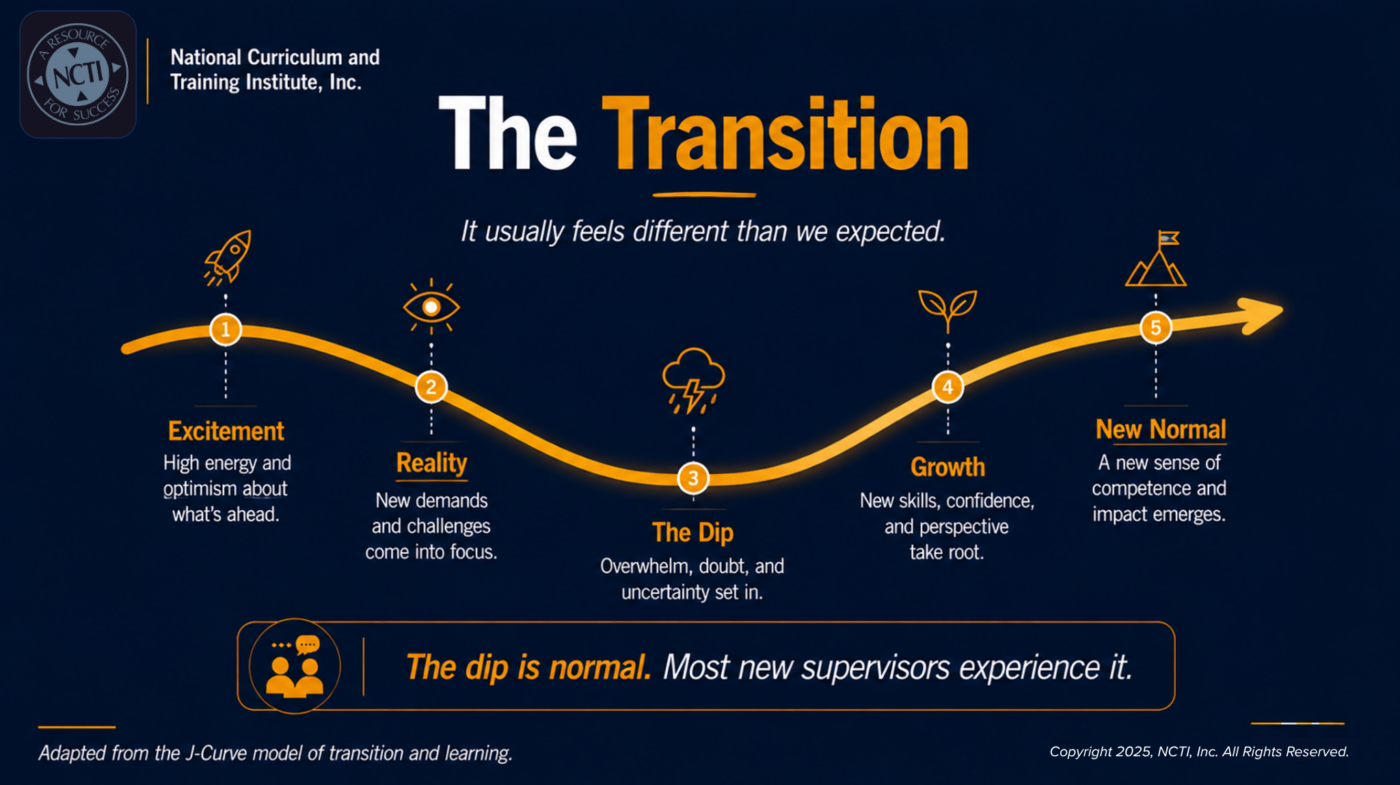
That process tends to follow a predictable arc, sometimes called a J-curve. It starts with excitement: high energy and optimism about what’s ahead. Then reality sets in, as new demands and challenges come into focus. Many new supervisors then hit the dip which is a period of overwhelm, doubt, and uncertainty. From there, with time and support, comes growth: new skills, new confidence, a broader perspective. Eventually, a new normal takes hold, marked by a genuine sense of competence and impact.
The dip is normal. Most new supervisors experience it, and naming it as a predictable stage, rather than a personal shortcoming, is often the beginning of a path through it.
Organizational psychologist William Bridges offers a useful way to think about what’s happening during that dip. He describes transition as unfolding in three phases: endings, where a leader lets go of old habits, an old identity, and the comfort of being the expert; the neutral zone, where new expectations, new relationships, and new responsibilities feel unfamiliar and uncertain; and new beginnings, where a new identity, new skills, and a new way of leading start to take root (Bridges, 2009).
There’s no shortcut through the neutral zone. The transition has to be moved through, not skipped over. What helps is understanding which specific shifts define that movement, and three stand out as the most common among new supervisors.
Shift #1: From Doing the Work to Leading the Work
Before a promotion, success usually looks like solving problems, providing answers, and doing the work directly. Those are the exact skills that get someone noticed for leadership in the first place.
After a promotion, the job changes. Success now means developing people, asking questions instead of supplying answers, and leading the work rather than doing it. In practice, that looks like coaching instead of correcting, delegating instead of absorbing tasks, and creating opportunities for others instead of stepping in to handle things oneself.
This shift is often the hardest to accept, because it can feel like doing less. In reality, a supervisor’s success is now measured by the team’s success, not by how much the supervisor produces on their own.
Shift #2: From Avoiding Conversations to Having Conversations
Every new supervisor eventually faces a conversation they’d rather not have: about a missed deadline, a performance gap, or a conflict between team members. The instinct, especially early on, is often to wait too long, hope the issue improves on its own, or talk around it instead of addressing it directly.
Effective leaders learn to do the opposite: address issues early, prepare for the conversation instead of winging it, and approach it with curiosity and clarity rather than assumptions. In practice, that means addressing issues while they’re still small, using clear and direct language, and asking questions before jumping to conclusions.
The conversations a new supervisor avoids don’t disappear. They usually come back later, larger and more difficult to have. Difficult conversations rarely get less so by waiting.
Shift #3: From Leading Everyone the Same to Leading People Differently
Treating every employee identically feels fair, and it’s often mistaken for good, consistent leadership. But consistency in approach and consistency in outcome are not the same thing. One person on a team may need clear expectations to feel confident in themself. Another may need encouragement and connection. A third may want autonomy and flexibility, while someone else needs details and time to think something through before actioning on it.
Effective leaders adjust by asking a few consistent questions: What does this person need from me? What helps this person do their best work? How can I adapt my approach to fit them?
In practice, this shows up as listening first, adjusting one’s own style rather than expecting others to adjust to it, and building real trust with each person individually, rather than assuming a single leadership style will work for an entire team.
Different people need different things from their leader. Recognizing that isn’t inconsistency, it’s what effective leadership actually requires.
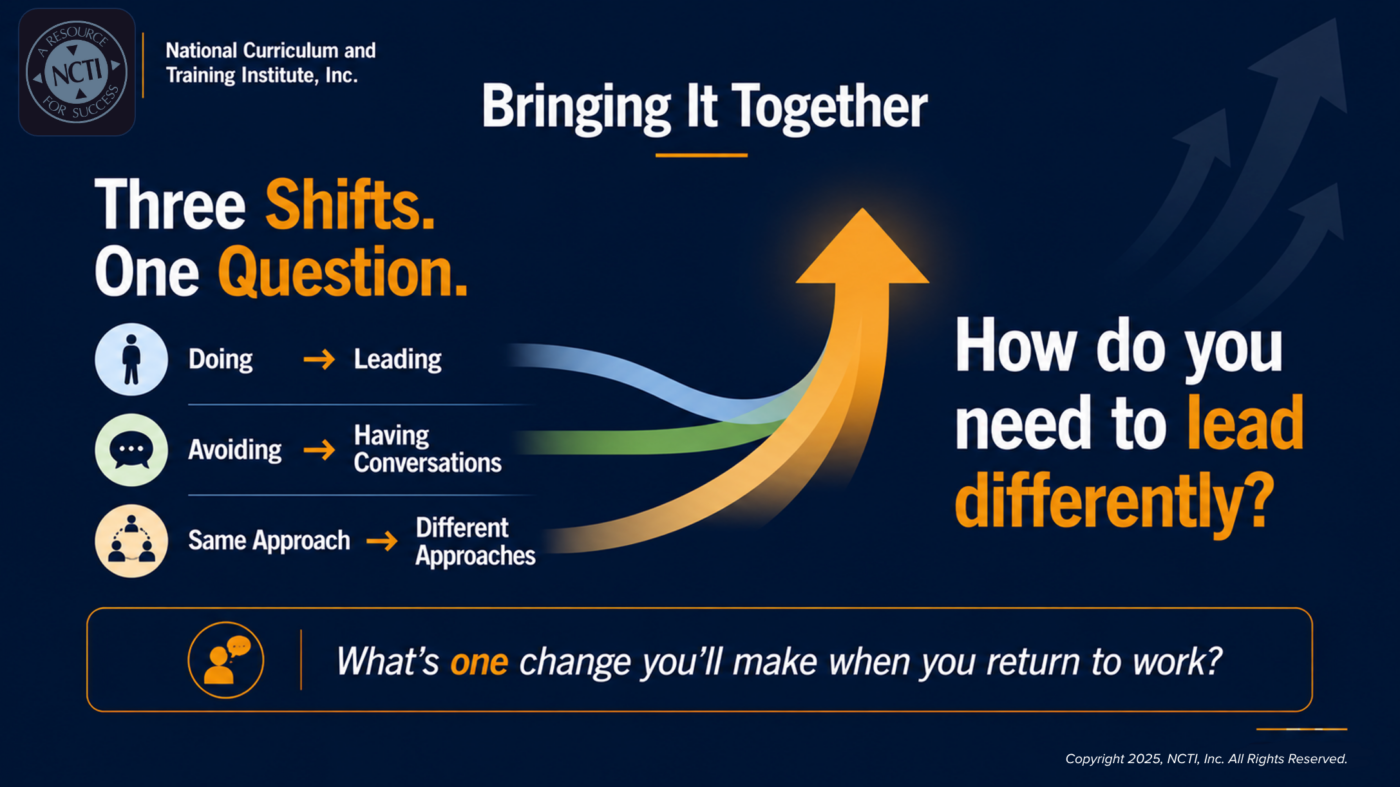
Bringing It Together: One Question
Three shifts: from doing to leading, avoiding to having conversations, and one approach to different approaches, they all point back to a single question every supervisor should be asking on a regular basis: How do you need to lead differently? There’s no single right answer, because the answer depends on the team, the moment, and the individuals involved. But the willingness to keep asking the question is itself a mark of effective leadership.
One Change This Week
New supervisors do not need to overhaul their entire style overnight. Small shifts can have a big impact. A useful next step is to pick just one behavior to change this week: one conversation to stop avoiding, one team member to lead a little differently, or one task to hand off instead of doing it personally.
That single change, repeated and built upon, is often what separates a supervisor who’s simply managing the transition from one who’s actively growing through it.
Supporting the Shift
None of these three shifts happen automatically just because a title changed. They take practice, self-awareness, and often, better tools for understanding the people being led.
This is where a resource like Real Colors® can help. By giving supervisors a common, practical language for recognizing what motivates different personality types, it directly supports the third shift — leading people differently — while also strengthening the communication skills that make difficult conversations easier to navigate.
Agencies looking to support new supervisors through this transition don’t have to leave it to chance. The right combination of leadership development and communication tools can turn a difficult promotion into a lasting leadership strength.
Interested in attending a Real Colors Workshop and seeing how this tool can help you and your team? Fill out the form below.
Connect with NCTI
Reference
Bridges, W. (2009) Managing Transitions, Making the Most of Change (3rd Edition). Philadelphia, PA. Da Capo Press.